
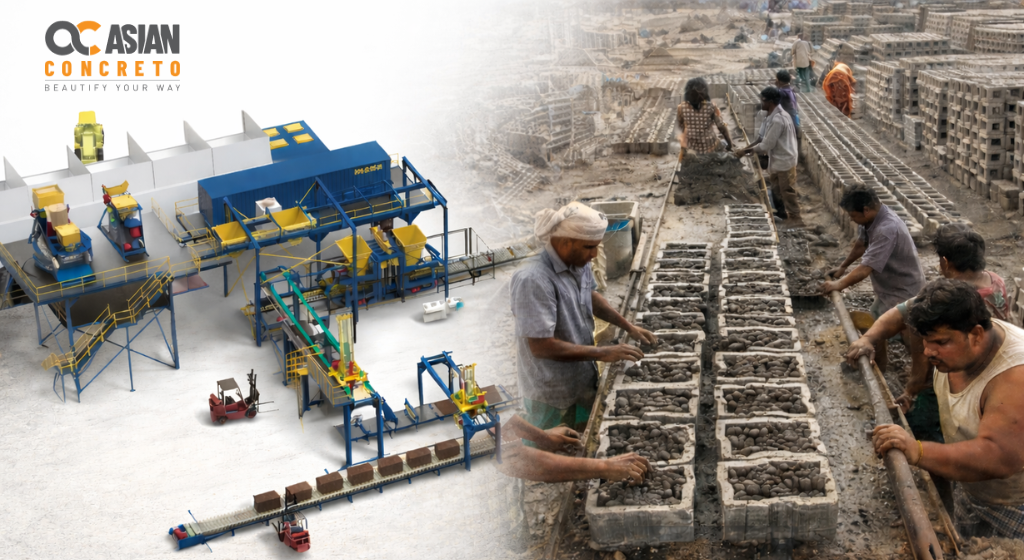
German Technology vs Local Manufacturing: Why It Matters in Construction
When you are walking along a beautifully paved street or a well-designed commercial complex, you rarely stop to think about the machines and processes that shaped every block beneath your feet. Yet the technology behind concrete manufacturing makes all the difference in how long those surfaces last, how evenly they look, and whether they crack under Nepal’s monsoon rains or bear up under the weight of heavy vehicles.
The construction industry across Nepal and India is growing rapidly. With that growth here comes a critical question for builders, architects, contractors, and homeowners: Does it matter whether your concrete blocks, pavers, tiles, and kerbstones were made using German technology or produced by a standard local manufacturing process? The answer is a definitive yes, and understanding why can save you from costly repairs, rejected projects, and poor-quality outcomes.
The Construction Quality Problem in Nepal
Nepal’s construction market is booming. Government-led infrastructure projects, rapid urban expansion in the Kathmandu Valley, growing commercial real estate in cities like Pokhara and Chitwan, and cross-border projects in the Indian market have all driven enormous demand for concrete products.
But demand does not always equal quality. The Nepalese construction materials market has historically faced several challenges:
- Lack of technology: Many local manufacturers in Nepal rely on semi-manual or outdated machinery that produces inconsistent results.
- Unorganized industry: Without standardization or strict quality benchmarks, product strength, dimensions and durability can vary significantly from batch to batch.
- Skilled labor gaps: Proper concrete mixing, vibration compaction, and curing are highly technical processes that require precision processes easily compromised without automation.
- Raw material variability: Aggregate quality, cement ratios and water content fluctuate in manual operations, directly impacting the final product’s compressive strength.
For buyers whether it is a homeowner paving a driveway or a government contractor laying kerbstones along a highway these inconsistencies translate into real-world failures: surfaces that crack prematurely, blocks that chip, and pavements that deteriorate within a few monsoon seasons.
This is precisely where the choice of manufacturing technology becomes decisive.
What Makes German Technology Different?
Germany has long held a global reputation for engineering precision, quality control, and industrial manufacturing excellence. In the concrete products industry, German engineering particularly through systems incorporating Siemens PLC controls, advanced vibro-compaction technology, and automated curing chambers has set an international benchmark that other manufacturing approaches simply have not matched.
1. Siemens PLC Control Systems
German-engineered concrete block machines are built around Programmable Logic Controllers (PLCs) most notably from Siemens, one of the world’s most trusted industrial brands. These systems automate every stage of the manufacturing process: feeding, mixing, vibration, compaction, de-molding, and transport. The result is consistent repeatable production with zero room for human error in the critical formation stage.
In comparison, semi-manual or basic local machines often depends on operator judgment for timing and compaction pressure. Any variation in fatigue, attention, or skill level directly impacts the quality of every individual block.
2. Advanced Vibro-Compaction Technology
One of the most important factors in concrete block strength is how well the concrete is compacted into the mould. German manufacturing systems use a dual vibration approach combining both static and dynamic vibration tables. This dual-vibration system ensures the concrete is compacted uniformly throughout the block, minimising air voids and maximising density.
When vibration and pressure are precisely controlled, the concrete becomes denser, air voids are minimised and the final product achieves superior strength and a more refined surface finish. The uniformity is visible and measurable in every block that leaves the production line.
Local machines often use single-frequency vibration systems or vibration that is inconsistently applied, resulting in blocks where internal air pockets compromise structural integrity and long-term durability.
3. Automated Curing Chambers
Curing is the stage where concrete blocks develop their true strength. It requires precise control of temperature and humidity over a defined period. German manufacturing lines use state-of-the-art automated curing chambers that maintain optimal conditions throughout ensuring each block reaches its intended compressive strength.
Without controlled curing, blocks may feel hard on the surface but remain structurally weak internally a problem that only becomes apparent months later under load or weather stress.
4. ISO and NS Standard Compliance
German-technology manufacturing systems are designed to meet international quality standards including ISO certifications and Nepal’s NS (Nepal Standard) compliance requirements. This means dimensional accuracy, consistent compressive strength ratings and verified surface quality across every batch produced.
For contractors working on government projects or large-scale commercial developments, this compliance is not optional. Products that fail to meet NS or ISO standards risk rejection on-site, project delays, and financial penalties.
| Feature | German Technology | Standard Local Manufacturing |
|---|---|---|
| Process Control | Siemens PLC fully automated | Manual / semi-manual |
| Vibration System | Dual static + dynamic vibration | Single-frequency or manual |
| Curing Method | Automated heat/humidity-controlled chambers | Open-air or basic curing |
| Dimensional Accuracy | Precision-moulded, consistent batch-to-batch | Variable across batches |
| Compressive Strength | Meets/exceeds ISO & NS standards | Inconsistent strength ratings |
| Surface Finish | Uniform texture, professional-grade finish | Variable surface quality |
| Production Volume | High-capacity: 24,000-30,000 blocks / 10 hrs | Lower capacity, variable output |
| Quality Certifications | ISO, NS, CE compliant | Often uncertified |
| Defect/Rejection Rate | Minimal – tight tolerance controls | Higher rejection rates |
| Long-Term Durability | Designed for decades of performance | Subject to early wear and failure |
Real-World Impact: What You Get and What You Risk
The comparison above reads like a specification sheet, but what does it mean for you on the ground?
For Homeowners and Residential Projects
If you are paving a driveway, garden path or courtyard, the choice of concrete paver quality directly affects your investment. German-technology-manufactured pavers offer superior skid resistance, consistent colour pigmentation, and long-term durability against Nepal’s extreme temperature swings and heavy monsoon rainfall. Locally manufactured pavers with inconsistent compaction can develop surface scaling, cracking and colour fading within just a few seasons.
For Architects and Landscape Designers
Dimensional accuracy is non-negotiable for professional design outcomes. When pavers vary in thickness or size which is common with non-automated production laying patterns break down, visible gaps appear, and the finished surface looks amateurish. German-engineered blocks deliver the dimensional consistency that allows herringbone, basketweave, and other precision laying patterns to execute perfectly.
For Builders and Contractors
On commercial or government projects, product quality failures are costly. Rejected material on-site, rework labour, and project timeline delays all erode margins. Selecting ISO and NS-certified products manufactured to German engineering standards removes this risk and provides documentation that satisfies procurement requirements.
For Long-Term Value
High-quality concrete products manufactured with German technology are designed to last for decades with minimal maintenance. The upfront cost difference between certified German-technology products and lower-quality alternatives is consistently outweighed by the reduced maintenance, replacement, and repair costs over the product’s lifespan.
Why Asian Concreto Uses German Technology and What It Means for You
Asian Concreto was built on a clear conviction: Nepal deserves concrete products that meet the highest international standards. As Nepal’s first and only concrete landscaping company exporting to the Indian market, Asian Concreto has invested in a fully automated manufacturing plant powered by state-of-the-art German technology, bringing every advantage described in this article directly to buyers in Nepal and India.
- Siemens PLC-controlled automated production ensures every paver, tile, kerbstone, block, and brick is manufactured with zero tolerance for error.
- Dual vibro-compaction technology guarantees uniform density and compressive strength across every product.
- Automated curing chambers optimize block strength and surface integrity at every stage.
- ISO and NS standard compliance ensures all Asian Concreto products are accepted on government, commercial, and residential projects without question.
- An independent aggregate crushing plant ensures raw materials are tested and meet stringent quality benchmarks before entering production.
The result is a product line including Asian Rectangular Pavers, Asian Cobble Pavers, Asian Hexagon Pavers, Asian Permeable Pavers, Kerbstones, Blocks, Bricks and Tiles that consistently outperforms locally manufactured alternatives in strength, finish, durability, and dimensional accuracy.
Asian Concreto’s completed projects across Nepal from the Yodha Ram Mandir to commercial and residential developments spanning Kathmandu, Lalitpur, Chitwan, Pokhara, and beyond, as well as landmark projects in Ayodhya and Gorakhpur in India are a testament to what German-technology manufacturing makes possible.
How to Choose Quality Concrete Products in Nepal: A Practical Guide
When evaluating concrete pavers, blocks, tiles, or kerbstones for your next project, use these criteria to ensure you are selecting genuinely quality products:
- Ask for NS and ISO certifications: Any serious manufacturer should be able to provide documented proof of compliance with Nepal Standard and ISO quality benchmarks.
- Request compressive strength data: Quality concrete pavers should meet or exceed 35 N/mm² (for pedestrian use) and up to 60 N/mm² for vehicular applications.
- Inspect dimensional consistency: Check multiple units from the same batch they should be identical in dimensions within ±1 to 2mm tolerance.
- Evaluate surface finish: A quality product will have a uniform, dense surface with no visible air pits, cracks, or color inconsistencies.
- Ask about the manufacturing process: German-technology manufacturers with automated production can describe their process in detail including vibration system type, curing method, and QC protocols.
- Check for a local track record: Look at completed projects. Visit sites if possible. Quality products speak for themselves over time.
Frequently Asked Questions
1. Why is German technology better for concrete manufacturing?
German technology in concrete manufacturing offers fully automated, precision-controlled production using Siemens PLC systems, advanced dual vibro-compaction, and automated curing chambers. These processes eliminate human error, ensure consistent compressive strength, and produce blocks that meet or exceed ISO and NS international quality standards outcomes that manual or semi-automated local manufacturing cannot reliably achieve.
2. What is the difference between German-manufactured and locally made concrete blocks?
The primary differences lie in consistency, strength and compliance. German-technology blocks are produced with dimensional accuracy within tight tolerances, uniform density from automated compaction and certified strength ratings. Locally manufactured blocks often have variable dimensions, inconsistent strength, and higher defect rates all of which create problems during installation and over the product’s lifespan.
3. Are Asian Concreto products ISO and NS certified?
Yes. Asian Concreto is Nepal’s first company to manufacture NS-certified Pavers and Kerbstones, and all products are produced in compliance with both ISO and Nepal Standard quality benchmarks. This certification covers raw material testing, production process controls, and final product inspection.
4. How do I choose the best paver blocks in Nepal?
Look for NS and ISO-certified products from a manufacturer using automated German technology production. Verify compressive strength ratings appropriate to your use case (pedestrian vs vehicular), inspect sample dimensional consistency, and review the manufacturer’s completed project portfolio. Asian Concreto’s range of pavers, tiles, blocks, and kerbstones meets all of these criteria.
5. Does Asian Concreto supply concrete products outside Kathmandu?
Yes. Asian Concreto supplies products across all major districts of Nepal including Lalitpur, Bhaktapur, Chitwan, Pokhara, Rupandehi, Banke, Dhanusa, Morang, and many more as well as exporting to India, with active projects in Lucknow, Ayodhya, Gorakhpur, and Varanasi.
| Ready to Build with Nepal’s Best?
Asian Concreto’s German-technology-manufactured pavers, tiles, kerbstones, blocks, and bricks deliver the quality your project deserves. Explore our full product range or get in touch with our team for a consultation.→ Explore Products: www.asianconcreto.com/products/ → Contact Us: +977-9802711199 | Kalikasthan, Kathmandu, Nepal |
Recent Blog


Other Articles

Kerbstone Price in Nepal: Types, Sizes, Grades and Buying Guide
Buying the right kerbstone is not always as simple as comparing prices. Many homeowners, contractors, and...

Best Pool Deck Pavers & Poolside Areas in Nepal: Slip-Resistant Guide
A wet pool deck is one of the easiest places to slip and get hurt. It...
How Much Do Pavers Cost in Nepal? Complete 2026 Pricing Guide
Quick Answer: Concrete pavers in Nepal cost between NPR 40 and NPR 130 per piece depending...
Permeable Pavers: The Future of Flood-Resilient Urban Infrastructure in Nepal
Every monsoon season, the same story repeats across Kathmandu, Pokhara, and dozens of other Nepali cities....

Lumbini Walkway Footpath Project: A Case Study of Modern Urban Walkway Development
Lumbini Walkway Footpath Project is a strong example of how good infrastructure can turn public spaces...

The Architect’s Choice: 10 Premium Building Materials in Nepal for Mastering the Outdoors
If you have been searching for trusted building materials in Nepal that actually hold up through...

Blocks in Nepal: Types, Uses, Prices & Trusted Manufacturers
The construction industry in Nepal has been evolving rapidly, with urbanization, infrastructure development, and a demand...
Building Sustainable Infrastructure in Kathmandu with Asian Concreto
Kathmandu Valley’s unique environment demands building materials that are strong, reliable, and suited to its climate...